



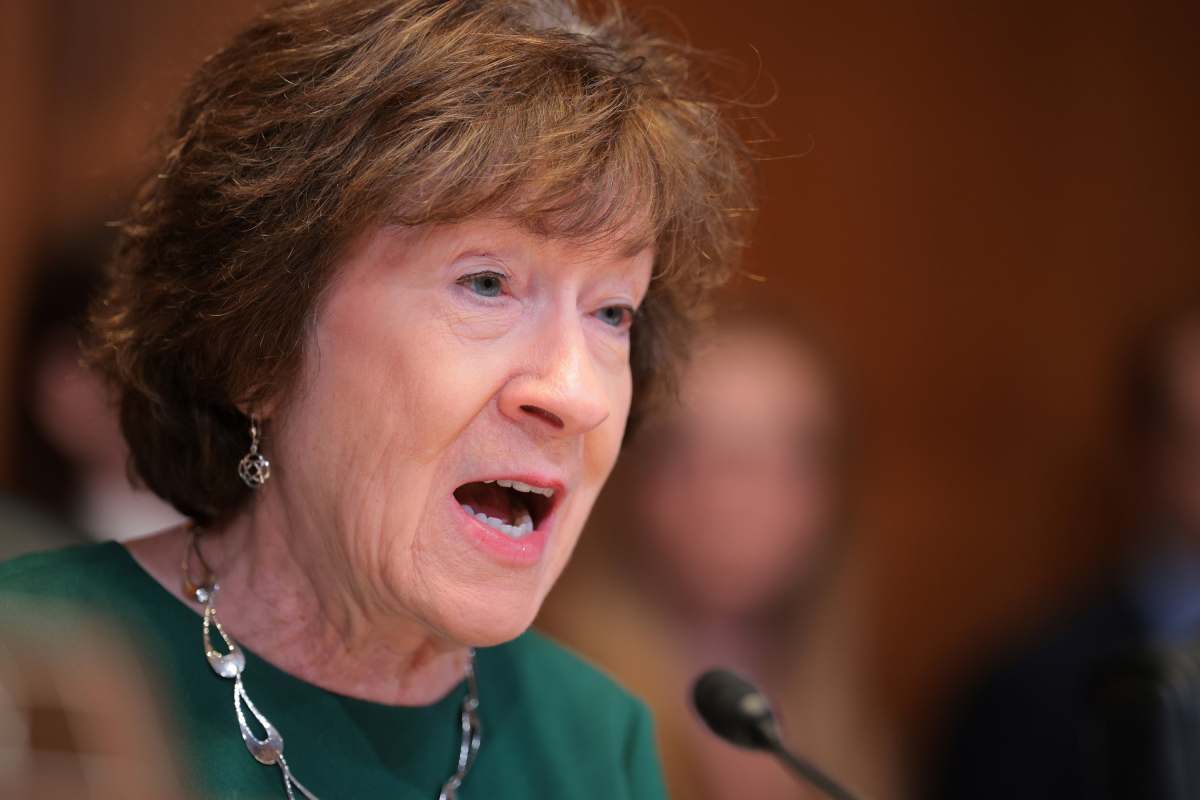
Democrats are at their strongest-ever position against Senator Susan Collins ahead of Maine’s 2026 Senate election, prediction markets and recent polling show.
With control of the Senate expected to hinge on a handful of races, Maine has emerged as one of the Democrats’ clearest pickup opportunities.
A Collins defeat would end the last New England Republican Senate tenure and reshape both parties’ national midterm strategies.
Why It Matters
Collins’ political brand has long defied gravity. She has survived wave elections, nationalized partisan cycles, and repeated polling deficits by assembling a coalition that stretches well beyond the Republican base.
That durability is precisely why the latest numbers—both from polls and prediction markets—are drawing attention. Multiple independent indicators are converging to suggest that Collins may be entering genuinely dangerous territory in a state that has become steadily more Democratic at the presidential level.
What Prediction Markets Say
On prediction markets, Democrats’ implied chances of defeating Collins have now reached record highs.
Kalshi, a regulated U.S.-based prediction platform, currently prices a Democratic victory in the Maine Senate race at 73 percent, leaving Republicans—including Collins—at 27 percent.
Trading volume on the market has exceeded $300,000, reflecting sustained interest rather than a short-lived spike.
Benjamin Freeman, Politics Growth at Kalshi and an election prediction specialist since 2019, flagged the shift on social media: “New all-time high. Democrats have a 73 percent chance of defeating Susan Collins in the Maine Senate race.”
Polymarket, a separate crypto-based platform popular among political traders, paints an even bleaker picture for the incumbent.
There, Democrats are priced at roughly 76 percent to win the seat, compared with 22 percent for Republicans, based on tens of thousands of dollars in matched wagers.
Prediction markets aggregate the collective judgment of thousands of traders, each putting real money behind their beliefs.
In theory, that makes them responsive to new information—polls, endorsements, fundraising signals—often faster than traditional forecasting models.
Their advantage lies in synthesis. Unlike a single poll, markets absorb many inputs at once.
Their weakness is just as important: traders can overreact, misprice familiar candidates, or assume linear trends in races that rarely behave that way.
In Maine, that caveat carries particular weight. Collins famously trailed Democrat Sara Gideon in nearly every major poll during the closing weeks of the 2020 election, only to win by nine points.
For Maine observers, that experience still serves as a brake on overconfidence. However, the current environment is not a carbon copy of 2020.
What Polls and Election Forecasts Say
Unlike that race, Collins now faces a Democratic field converging rapidly around a single challenger: oyster farmer and political outsider Graham Platner.
Recent polling shows Platner consolidating Democratic support earlier than expected and outperforming Governor Janet Mills in head-to-head matchups against Collins.
The latest poll from the Maine People’s Resource Center (MPRC), released April 7, surveyed 1,168 likely voters and found Platner leading Collins 48 percent to 39 percent, with 12 percent undecided. The margin of error was plus or minus 2.9 percentage points.
That same survey placed Platner well ahead in the Democratic primary, 61 percent to 28 percent over Mills—a striking 33-point margin as primary day approaches this summer.
MPRC said the numbers represented a clear shift from October 2025, when its polling showed a near tie in the Democratic contest and a much narrower general election margin.
Other surveys reinforce the trend. An Emerson College poll conducted March 21–23 among 1,075 likely voters found Platner ahead 48 percent to 41 percent over Collins. A separate Emerson matchup showed Mills leading Collins by three points.
Across polls, one throughline emerges: Collins’ standing among independents has eroded sharply.
Emerson reported Collins with a 30-point net unfavorable rating among independent voters, while Platner posted a modest but meaningful net positive with the same group.
Ranked-choice voting adds another layer of uncertainty. While Collins has historically benefited from it, the system can just as easily accelerate consolidation against an incumbent once voter preferences harden.
Across multiple April 2026 polls, Collins trails by six to nine points against Platner in hypothetical general election matchups.
Those margins help explain why prediction markets have moved so decisively.
Traders are not simply betting on dislike of Collins; they are responding to evidence that Democrats may exit their primary earlier and more unified than in past cycles.
Cook Political Report and Sabato’s Crystal Ball currently rate the race as a Toss-up, reflecting the tension between the data and Collins’ unique electoral history.
The Wild Card: Susan Collins Herself
Collins remains one of the most recognizable figures in Maine politics. Her campaign has leaned into her seniority, committee power, and reputation for independence—an argument that has worked before.
Her challengers, meanwhile, are attempting to puncture that image. Platner has argued that Collins only breaks with her party when her vote is not decisive, a critique designed to resonate with voters fatigued by partisan brinkmanship.
“When she breaks with her party, it’s almost always on votes that they’re gonna pass anyway. People understand what’s going on,” he told CBS13. “We’re not getting tricked by this.”
But whether that message breaks through statewide remains an open question.
Responding to Platner’s criticism, Collins said: “This sounds like talking points received by someone who either doesn’t know how the Senate works or hasn’t been paying attention.”
What Happens Next
The Democratic primary on June 9 will determine whether Platner’s momentum solidifies or fractures.
Maine has a way of reminding analysts that probabilities are not certainties, and veterans are rarely finished until the last ballot is counted.
Read the full article here


