



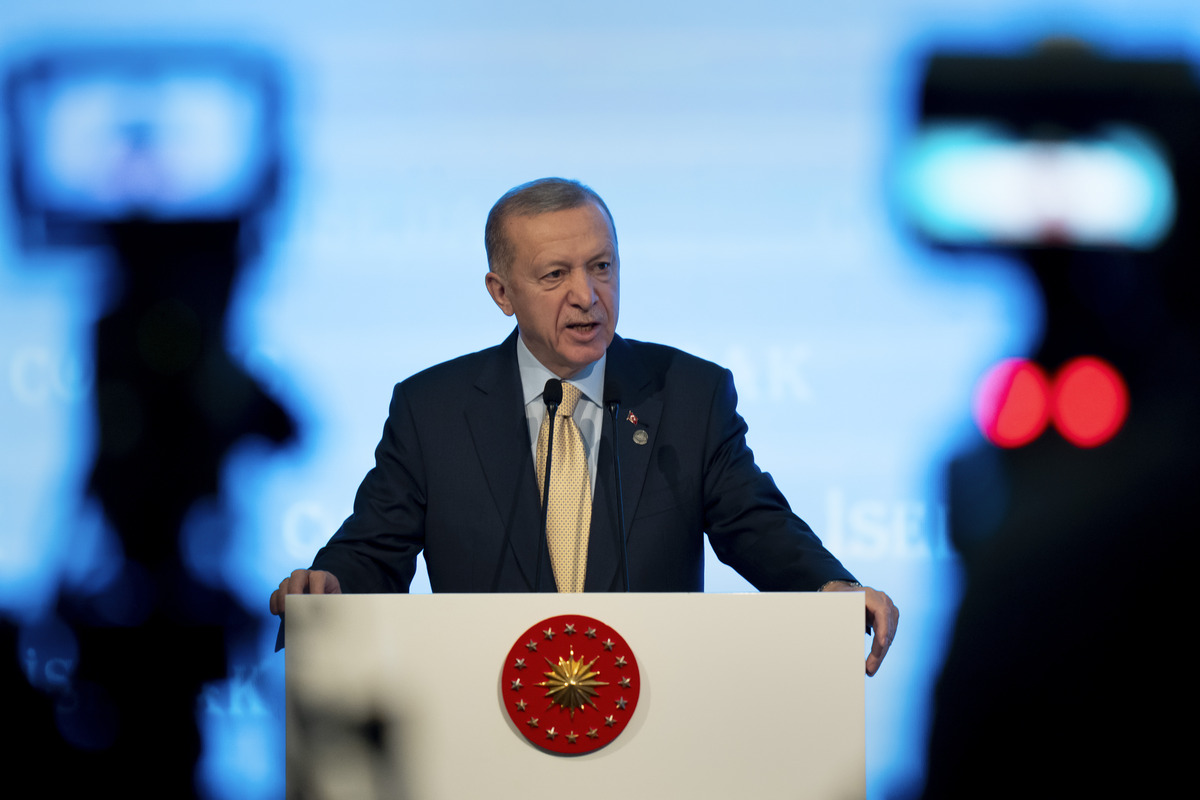
Turkey and Israel’s long-fraught relations are being strained by new diplomatic rows, fanned by resurfaced remarks from the Turkish president suggesting the NATO country could attack Israel.
Recep Tayyip Erdoğan, who had fiercely criticized Israel’s war in Gaza from 2023, said back in 2024 Turkey could intervene on behalf of Palestinians against “ridiculous” Israeli military actions, causing Israel to demand Turkey’s expulsion from NATO.
Erdoğan did not elaborate on what any intervention could look like at the time, but nodded to Turkey’s deployment of military personnel to Libya and support for Azerbaijan’s 2023 operation to retake the breakaway territory of Nagorno-Karabakh from ethnic Armenian forces.
Appearing to refer to these remarks, which circulated heavily from Sunday, Erdoğan’s office said the quotes were outdated and taken out of context. The president’s office said on Monday that Ankara was working for “an end to bloodshed” in the region and “lasting peace,” according to Turkish media.
But Israel and Turkey have exchanged a series of jabs over the weekend, worsening often turbulent relations between the two major regional powers, both of which have strong connections to the White House.
Open fighting between the two countries remains highly unlikely, and any new conflict breaking out in the Middle East would likely be very unpopular in Washington as U.S. officials still work to secure ceasefire deals.
Turkey is a NATO member, and could theoretically invoke the alliance’s Article 5 if it is attacked by Israel, which means all of NATO’s members—including the U. S.—would be obligated to discuss how to defend Turkey with their collective might.
Israel, meanwhile, is very close to the U.S., and it is difficult to imagine the U.S. not coming to Israel’s aid.
What Have Turkey and Israel Said?
On Saturday, Turkey’s foreign ministry described Israeli Prime Minister Benjamin Netanyahu as “the Hitler of our time,” referring to Nazi dictator Adolf Hitler, who was responsible for the Holocaust that killed more than 6 million Jews in Europe during World War II.
Ankara then referenced the International Criminal Court’s (ICC) arrest warrant for Netanyahu, the court accusing the Israeli prime minister and the country’s former defense minister, Yoav Gallant, of alleged crimes against humanity and war crimes.
The warrants relate to Israel’s war against Palestinian militant group Hamas in the Gaza Strip following the October 7 attacks on Israel in 2023, which killed approximately 1,200 people. Another 251 were taken as hostages into the territory, the survivors and the remains of those slain now returned to Israel.
Health authorities in Gaza say more than 70,000 people have been killed in the strip since Israel started its bombardment. A ceasefire that began in October stopped two years of full-scale war, but Israeli airstrikes have continued and Hamas still controls a sliver of Gaza.
Israel does not recognize the ICC’s authority. South Africa brought a separate case, accusing Israel of genocide in Gaza, to the International Court of Justice (ICJ), the United Nations’ top court, in December 2023. Israel rejects the allegations.
Netanyahu’s office and the Israeli Foreign Ministry have been contacted about the Turkish government’s statement referencing Hitler.
Although Turkey was the first Muslim-majority country to recognize Israel back in 1949, the Israeli war on Gaza helped fracture decades of relative calm—although Ankara had been increasing critical of Israel.
Netanyahu said in a social media post on Saturday that Israel would continue to fight Iran and Tehran-backed groups in the Middle East, “unlike Erdogan who accommodates them and massacred his own Kurdish citizens.”
The Turkish government has for years battled Kurdish militant groups, officials in Ankara deeming the Kurdistan Workers’ Party (PKK) a terror organization and a major security threat.
Kurds make up just under a fifth of Turkey’s population, with roughly 30 million ethnic Kurds living across the broader Middle East. Turkey has attacked Kurdish military sites in Iraq and Syria.
Aid Flotillas
Media had reports on Saturday said Turkish prosecutors were preparing to seek up sentences up to 4,596 years in prison for 35 people, including Netanyahu, over reported Israeli attacks on a flotilla carrying humanitarian aid to Gaza in September.
A new aid flotilla bound for Gaza left the Spanish city of Barcelona on Monday, and is likely to be another sore spot in Israeli-Turkish relations.
Israeli commandos killed 10 Turkish activists traveling with a flotilla attempting to break an Israeli blockade of Gaza in May 2010, causing relations between the two countries to break down for six years.
Turkey has also condemned “in the strongest terms” continuing Israeli attacks on Lebanon, after President Donald Trump announced a two-week ceasefire between the U.S., Israel and Iran.
Israel and the U.S. have been conducting joint attacks on Iran since February 28, while Tehran retaliated by targeting American allies in the Middle East and effectively blockading the vital Strait of Hormuz shipping lane.
Although Pakistan, which brokered talks between the U.S. and Iran, said the ceasefire covered Lebanon, Israel said it did not.
Israel has been carrying out airstrikes across Lebanon and ground operations in the south of the country since Iran-backed Hezbollah fired rockets into northern Israel in support of Tehran on March 2.
‘It Is Personal’
For Netanyahu and Erdoğan, “it is personal,” said Philip Kosnett, a former U.S. charge d’affaires in Turkey and ex-ambassador to Kosovo.
There’s a “strong personal dislike” between the two leaders, who spearhead nations that are “increasingly confident with using force to pursue their national interests,” said Kosnett, who is now a senior fellow with the Center for European Policy Analysis (CEPA) think tank.
Israeli attacks on Lebanon deepened the “animosity” between the countries, while Israel’s leadership sees Erdoğan as not just pro-Palestinian, but pro-Hamas, Kosnett told Newsweek.
Read the full article here


